
In the world of software development, writing secure, maintainable, and efficient code is a priority. One principle that every Java developer should master is the DRY principle—short for Don’t Repeat Yourself. By applying this principle effectively, developers can avoid redundancy, reduce errors, and improve the security of their applications.
This article explores the DRY principle in Java, why it is essential for professional developers, and how it directly contributes to secure software development.
Table of Contents
- What is the DRY principle?
- Why the DRY Principle Matters in Java Development
- Example of DRY Principle in Java
- DRY Principle and Secure Software Development
- 5 Best Practices to Apply DRY in Java
- Final Thoughts
What is the DRY principle?
The DRY principle was first introduced by Andy Hunt and Dave Thomas in their book The Pragmatic Programmer. It emphasizes:
👉 “Every piece of knowledge must have a single, unambiguous, authoritative representation within a system.”
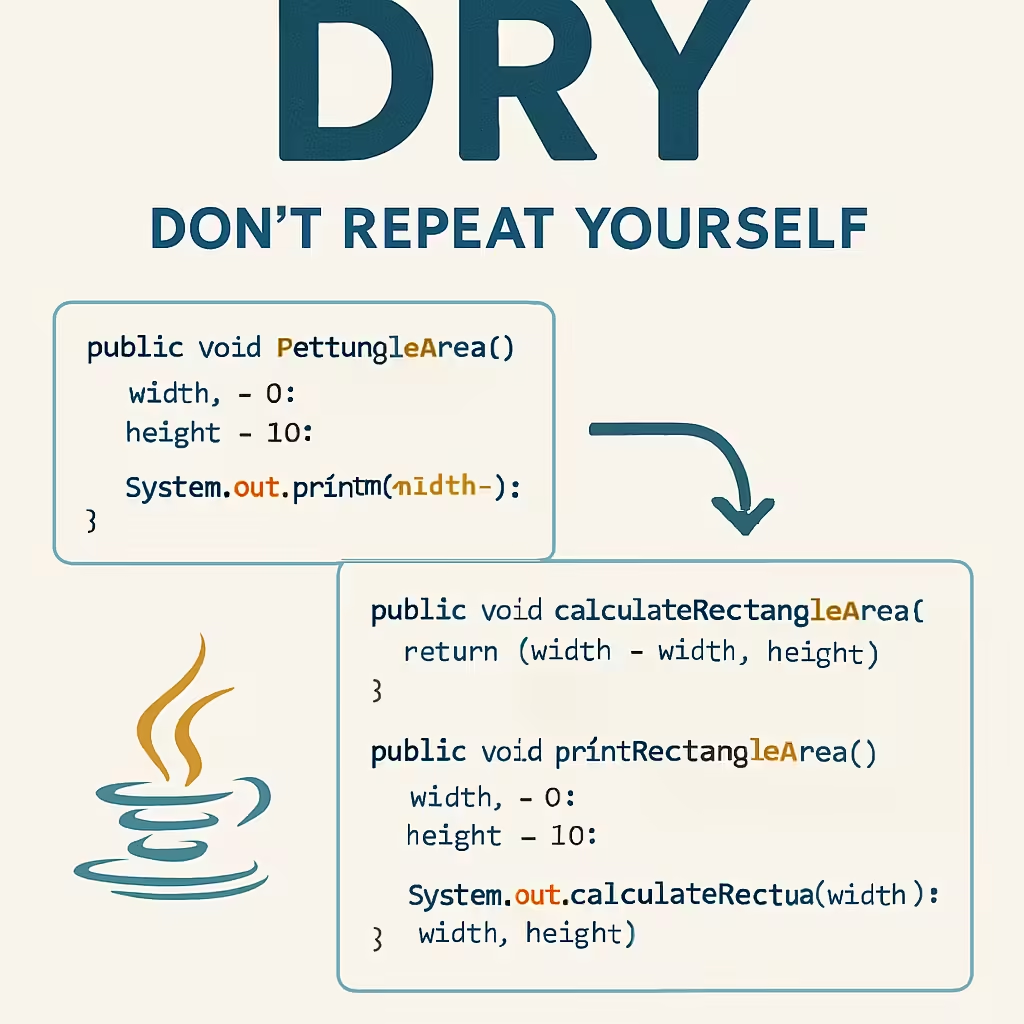
In simpler terms, the DRY principle in Java means avoiding code duplication by writing reusable logic. Instead of repeating the same code blocks, developers encapsulate logic into methods, classes, or libraries that can be reused across the project.
Why the DRY Principle Matters in Java Development
For professional developers, applying the DRY principle has several critical benefits:
- Maintainability—Changes or bug fixes need to be applied only once, minimizing the risk of inconsistencies.
- Readability—Clean, modular code is easier to read, understand, and review.
- Efficiency—Less code duplication reduces development time and accelerates debugging.
- Security—Centralized methods for validation, encryption, or authentication help enforce consistent security practices across the application.
Example of DRY Principle in Java
Consider the following example of percentage calculation.
❌ Without DRY Principle:
public class EmployeePerformance {
    public static void main(String[] args) {
        int score1 = 87;
        int score2 = 90;
        int score3 = 78;

        System.out.println("Performance 1: " + (score1 / 100.0) * 100);
        System.out.println("Performance 2: " + (score2 / 100.0) * 100);
        System.out.println("Performance 3: " + (score3 / 100.0) * 100);
    }
}
Here, the formula (score / 100.0) * 100 is duplicated multiple times.
✅ With DRY Principle:
public class EmployeePerformance {
    public static double calculatePerformance(int score) {
        return (score / 100.0) * 100;
    }

    public static void main(String[] args) {
        int score1 = 87;
        int score2 = 90;
        int score3 = 78;

        System.out.println("Performance 1: " + calculatePerformance(score1));
        System.out.println("Performance 2: " + calculatePerformance(score2));
        System.out.println("Performance 3: " + calculatePerformance(score3));
    }
}
The reusable method calculatePerformance() eliminates duplication and makes the code cleaner, more maintainable, and secure.
Want to see how this idea scales to large projects? Take a look at our article on Java design patterns for enterprise applications.
DRY Principle and Secure Software Development
For professionals, the link between DRY and security cannot be ignored. Here’s why:
- Centralized Security Logic: By placing authentication, input validation, or encryption in a single method or class, developers ensure that every part of the application follows the same rules.
- Reduced Vulnerabilities: Repeated code increases the chances of forgetting security checks in some places. DRY prevents this by enforcing consistency.
- Simplified Auditing: Security teams reviewing the code need to audit fewer areas, reducing the likelihood of missed vulnerabilities.
For example, instead of writing multiple user input validations across different modules, a professional developer can create a single reusable validation utility. This ensures that SQL injection, XSS, and other security risks are handled uniformly.
Best Practices to Apply DRY in Java
- Refactor Regularly – During code reviews, identify duplicated logic and refactor it into reusable methods or classes.
- Leverage Object-Oriented Programming (OOP): Use inheritance, abstraction, and interfaces to reduce repetition.
- Use Frameworks and Libraries: Java provides robust libraries for logging, validation, and encryption—avoid reinventing the wheel.
- Avoid Over-Abstraction: While DRY is powerful, overusing it can lead to unnecessary complexity. Strike a balance.
- Combine with SOLID Principles: DRY works best when paired with other principles like Single Responsibility and Open/Closed Principle.
Final Thoughts
The DRY principle in Java is more than just a coding best practice; it is a strategy for building secure, scalable, and professional software. For modern developers, mastering DRY ensures not only code efficiency but also security consistency across applications.
By avoiding code duplication, centralizing logic, and applying Java’s OOP features, professionals can reduce risks, improve maintainability, and strengthen their software against vulnerabilities.
In short, Don’t Repeat Yourself—write once, reuse everywhere, and secure your Java applications the smart way.
Happy Learning!!!!